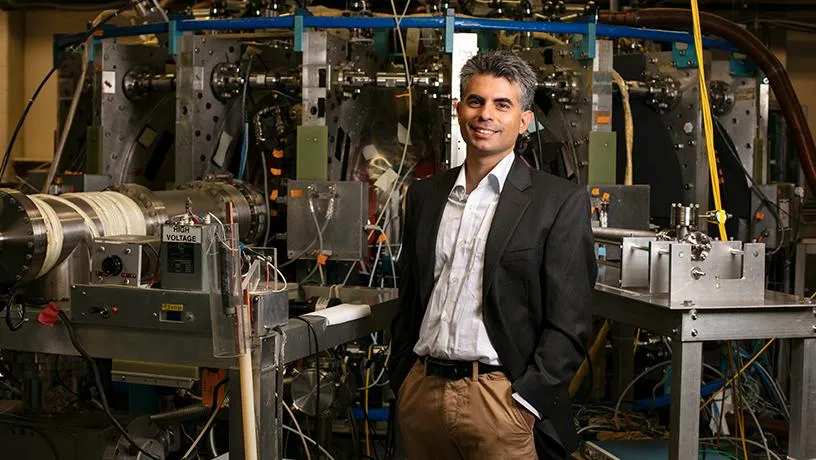
Professor Carlos Paz-Soldan has been named recipient of the 2021 Thomas H. Stix Award for Outstanding Early Career Contributions to Plasma Physics Research from the American Physical Society (APS). The prestigious award, which honors rising researchers who have accomplished outstanding theoretical, experimental, computational, or technical work across the field, recognizes his “groundbreaking contributions and scientific leadership in the understanding of non-axisymmetric magnetic fields and relativistic electrons in tokamak plasmas.”
“I’m extremely honored to be…
Associate Professor Carlos Paz-Soldan joined the Columbia University’s Department of Applied Physics and Applied Mathematics on January 1, 2021.
Michael E. Mauel, Professor of Applied Physics, received the 2020 Leadership Award from the Fusion Power Associates (FPA) for his outstanding leadership qualities.
The FPA Board recognized the leadership he has provided over several decades to both the scientific community and to national fusion program strategic evaluation and planning efforts. In particular, the Board made note of Prof. Mauel’s significant role as co-chair of the National Academies 2018 study, A Strategic Plan for U.S. Burning Plasma Research, that proposed “the United States should start a national program…
This week, Columbia University fusion scientists and students presented their latest results during the 62nd Annual Meeting of the APS Division of Plasma Physics. The APS-DPP Annual Meeting is the largest in the world, with more than 2,200 participants reporting the latest research in all areas of fundamental and applied plasma physics. To ensure the safety of all participants, this year’s Annual Meeting was virtual, with lectures presented and recorded over the internet.
Michael Mauel, Professor of Applied Physics, has been named a "National Associate of the Academies" by the National Academy of Sciences (NAS).
Allen H. Boozer, Professor of Applied Physics at Columbia University, is part of a stellarator group that has received a Simons Mathematical and Physical Sciences Award of $2M per year for four years. The Simons Foundation is particularly well known for funding applied mathematics and its applications to the fundamental sciences. Support for work as applied as the mathematical foundations of stellarators is noteworthy. The Foundation wants the title of the grant to clearly state the practical application, Hidden Symmetries and Fusion Energy.
The primary institutions participating in this project…
Students, scientists, and faculty presented their research at the 61st Annual Meeting of the APS Division of Plasma Physics, October 21-25, 2019. This year's meeting was located in Fort Lauderdale, Florida, where over 2,500 scientists from around the world gathered to present and learn the latest research in plasma physics and fusion science.
A highlight of the meeting was Dr. Andrea Garofalo (PhD Columbia 1997) who presented the opening plenary lecture titled "Understanding the MHD challenges for ITER Q=10 operation at reactor relevant conditions." Andrea Garofalo reported the recent discovery…
Two outstanding APAM alumni, Dr. Seth Davidovits and Dr. John C. Wright, received awards at the 60th Annual Meeting of the American Physical Society (APS) Division of Plasma Physics, which took place from November 5-9, 2018 in Portland, OR.
Seth Davidovits (B.S. ‘10, Applied Physics), received the 2018 APS Marshall N. Rosenbluth Outstanding Doctoral Thesis Award. The award recognizes “exceptional young scientists who have performed original thesis work of outstanding scientific quality and achievement in the area of plasma physics.”
Davidovits, who was the SEAS class of 2010 valedictorian,…
An annual reunion dinner for Columbia University Plasma Physics alumni, faculty, and current students took place during the 2019 Fall APS Plasma Physics Annual Meeting.
The dinner, organized by Ph.D. alum Ryan Sweeney, was also attended by Mel Abler, Alex Saperstein, Ben Israeli, Andrea Garofalo, Alexander Glasser, Alexander Battey, Boting Li, Brian Grierson, Chris Hansen, Daisuke Shiraki, David Maurer, Dennis Boyle, Ian Stewart, Ilon Joseph, Jack Berkery, Jeff Levesque, Jeremy Hanson, Juan Diego Riquezes, John Brooks, John Wright, Kenneth Hammond, Michael Mauel, Paul Hughes, Philip Efthimion,…
APAM senior research scientist and adjunct professor Dr. Steven A. Sabbagh will lead an expanded joint international grant from the U.S. Department of Energy (DOE) to study high performance tokamak plasma disruption prediction and avoidance in the long-pulse Korea Superconducting Tokamak Advanced Research (KSTAR) device located in Daejeon, South Korea. The expanded grant research will add further physics studies, real-time data acquisition, and plasma control to the device to understand how plasma disruptions can be largely eliminated in a tokamak. The granted funding expands past support…
The US Department of Energy’s Under Secretary for Science Paul Dabbar, along with Lane Genatowski, Senior Advisor to the Under Secretary and President Donald Trump's nominee to be Director of the Advanced Research Projects Agency-Energy (APRA-E), and Kristen Ellis, chief of staff to Dabbar, visited Columbia University's Department of Applied Physics and Applied Mathematics on April 9.
Under Secretary Paul Dabbar's visit included conversations with faculty, research scientists, and students. A highlight of the visit was the tour of Columbia's Plasma Physics Laboratory and the …