Industry
Industrially Sponsored Research is an important element of our Center's research program. Sponsor partnership levels and associated benefits are assigned based on the level of engagement.
Columbia's program has a strong focus on accelerating the growing fusion private sector. Using Sponsored Research Agreements (SRAs) our partners sponsor targeted research at Columbia. Research generally focuses on the plasma physics of each company's configuration, but can expand to other mutually beneficial areas.
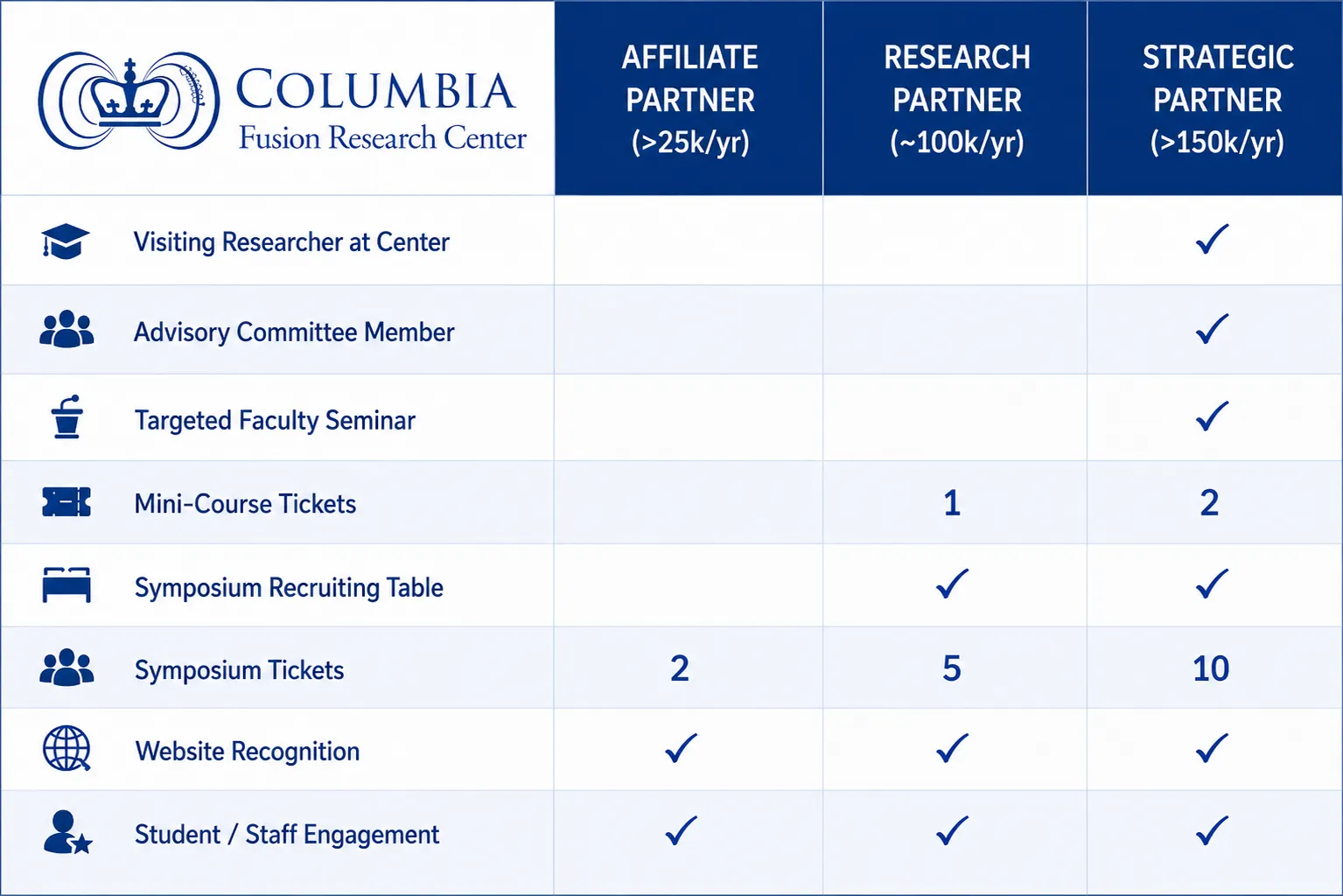
The above table lists the membership benefits available to groups that conduct sponsored research with our center. Benefits are aligned with active events such as the Professional Mini-Course and engagements with our Students and Faculty. We plan to offer an annual or semi-annual research symposium to further connect our sponsors with the quality talent available at Columbia.
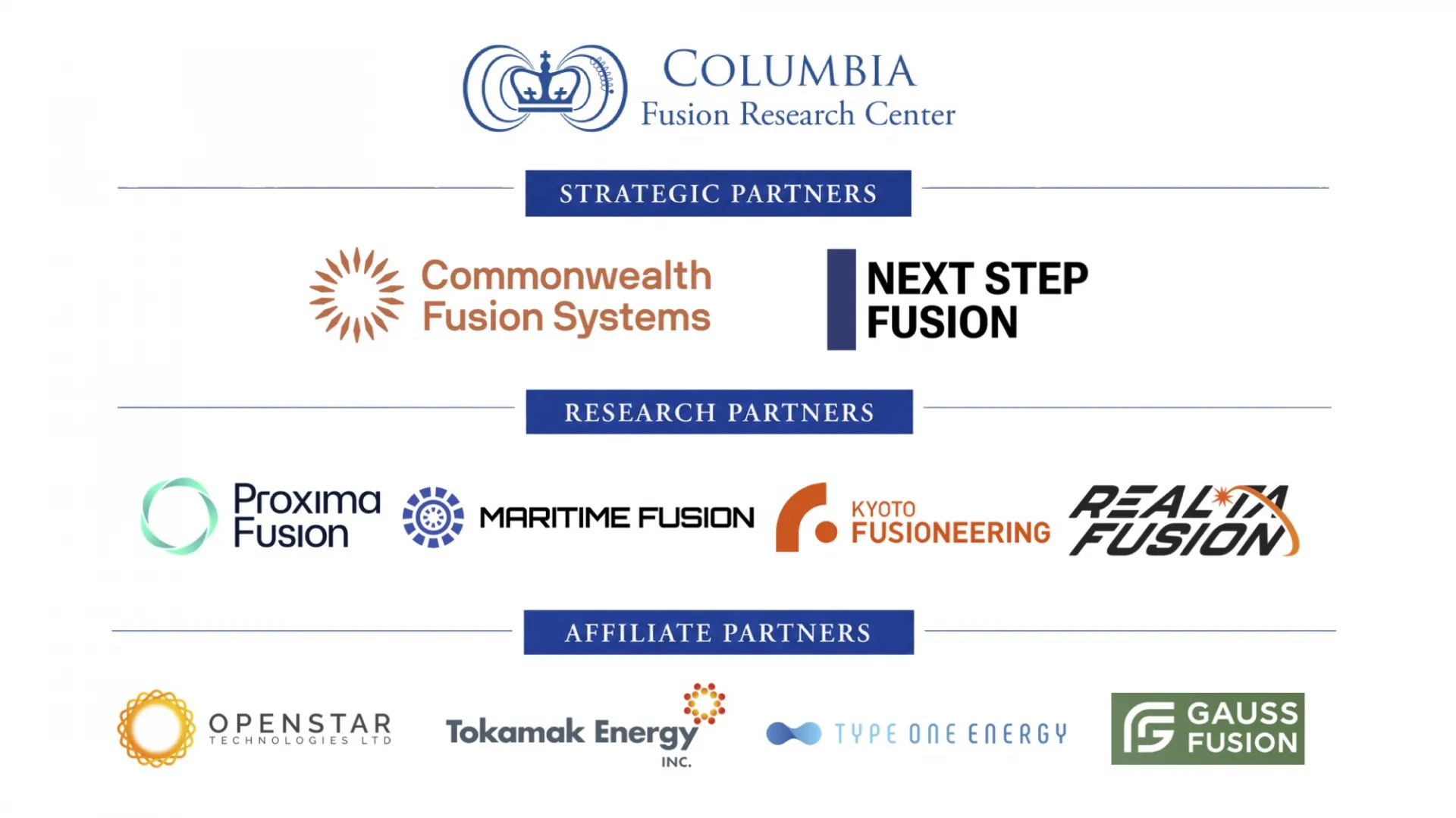
Based on the level of sponsored research activities at Columbia, our partners are listed above. Please expand the list below for a brief description of research with each partner.
Description of Sponsored Research Activities

Research with Commonwealth Fusion Systems (CFS) advances SPARC and ARC.
For examples of current research, please see recent publications:
Implications of Vertical Stability Control on the SPARC Tokamak
Optimization of the equilibrium magnetic sensor set for the SPARC tokamak
Design of passive and structural conductors for tokamaks using thin-wall eddy current modeling
Research with Next Step Fusion advances the design of negative triangularity tokamaks, with the first manuscript available on arXiv:
Electromagnetic System Conceptual Design for a Negative Triangularity Tokamak
Work with Proxima Fusion will advances the physics basis for their fusion pilot plant concept. Initial work will focus on energetic particle research.
Research with Open Star is bringing the capabilities of the Open Fusion Toolkit to the Dipole Configuration. This is a new collaboration and our first publications are in progress.

Planned research with Realta Fusion will bring the capabilities of the Open Fusion Toolkit to the mirror configuration.

Our research in support of Tokamak Energy's milestone program will focus on the physics of the edge plasma and pedestal region, integrated with our Edge Stability program.

Planned research with Kyoto Fusioneering will advance the Negative Triangularity Tokamak concept towards viability for application in the Japanese fusion ecosystem, with work similar to that done in the Fusion Systems Design area.

Research with Type One Energy advances the physics basis of the stellarator with an emphasis on energetic particles research. See more information here: Stellarator Physics

Work with Maritime Fusion is taking place in the area of tokamak pulse design with application to low power level outputs and long idle times as would be needed for maritime applications.

Work with Gauss Fusion is ongoing in the area of stellarator coil optimization.
Note: Membership tiers and associated benefits are assessed annually and are subject to change.