Fusion Pulse Design
Columbia scientists combine the most promising elements of tokamak research to produce stable and powerful plasmas.
Reactor Scenarios
"Negative triangularity" refers to a shape parameter of tokamak plasmas, designating a shape distinct from those preferred in ITER or Hybrid scenarios. Most cutting edge plasmas feature a "D" shaped cross section, as this shape generally enhances performance metrics. Negative triangularity scenarios invert this "D" to face inward toward the central solenoid. This improves confinement and allows tokamaks to operate at high power in the easier to control, lower confinement, 'L-mode' regime. Professor Carlos Paz-Soldan and Dr. Oak Nelson have lead the work on negative triangularity physics, starting at the DIII-D Tokamak and expanding to various international machines. Negative triangularity research has recently enjoyed more attention from the international plasma physics community, and exploratory work at Columbia in this interesting regime is underway.
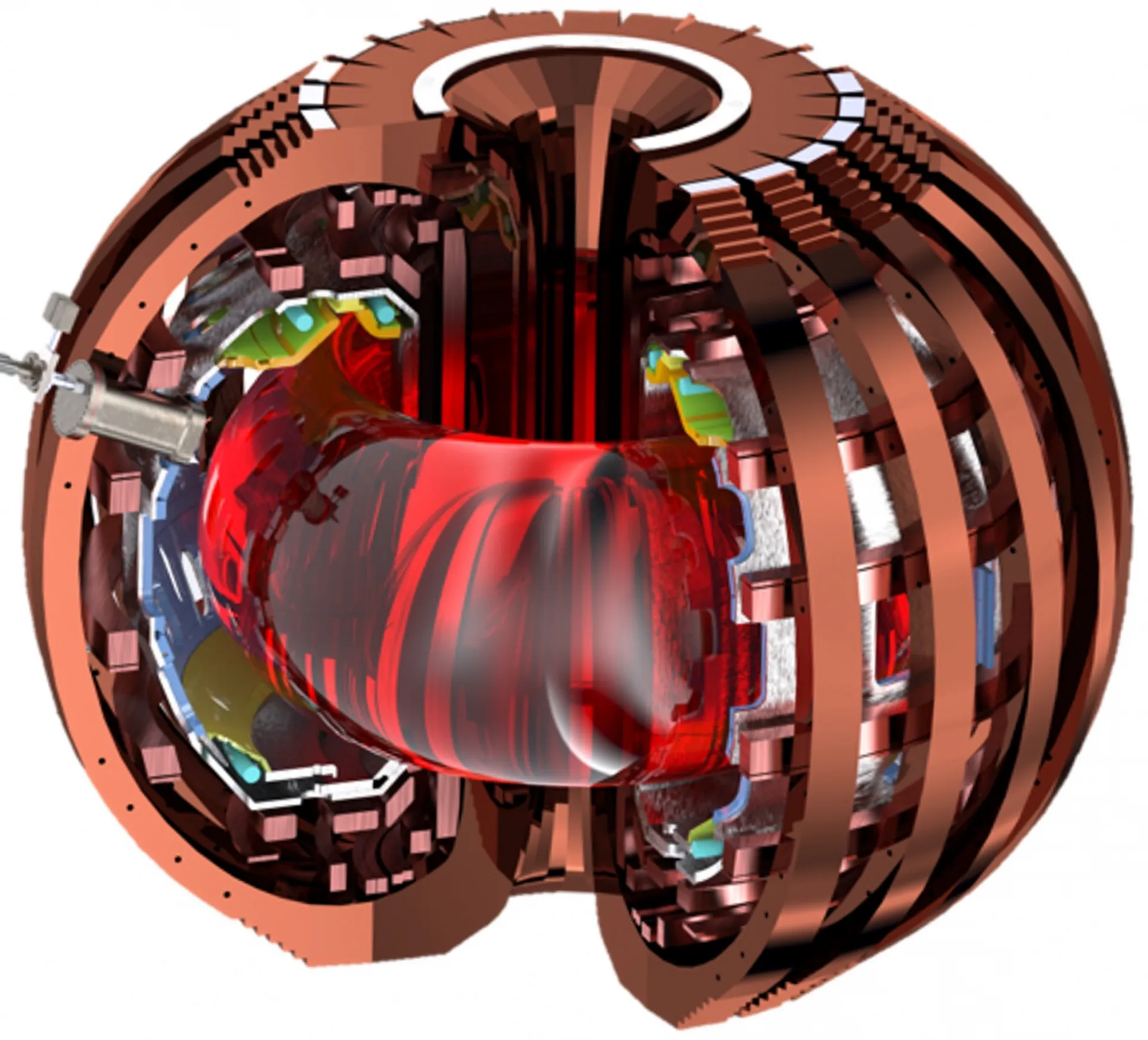
Pulse design is a critical enabler for next-generation tokamaks because it integrates physics performance, engineering limits, and operational reliability into a single, executable scenario. Advanced devices operate close to stability, thermal, and material boundaries; poorly coordinated waveforms for current, density, shape, and heating can rapidly erode performance or violate machine constraints. Well-designed pulses ensure that desirable confinement regimes are accessed intentionally and sustainably, with controlled transitions, managed heat and particle exhaust, and acceptable loads on plasma-facing components. They also provide the framework for coordinating multiple actuators (auxiliary heating, fueling, shaping, and control systems) over long pulse durations. In this sense, pulse design is not a post-processing step but a core element of scenario development, translating theoretical operating regimes into repeatable, reactor-relevant operation for future tokamaks.
Work in this area utilizes the Open FUSION Toolkit developed at Columbia University.
Inductive scenarios are inherently pulsed, as they are sustained by ramping a central solenoid, inducing a large plasma current. The International Thermonuclear Experimental Reactor (ITER) aims to achieve its mission of producing a fusion reaction efficiency of ten running an inductive scenario, the Iter Baseline Scenario.
ITER represents a major step toward realizing fusion energy's potential. Though ITER will be a research machine, tokamaks with similar parameter space access and size are candidates for fusion power generation. Time will tell whether these power plants operate inductively or noninductively.
Non-inductive, steady-state scenarios rely on operation at high normalized pressure and utilize less plasma current than inductive scenarios. The plasma current in these non-inductive scenarios is generated by neutral beam injection, electron cyclotron systems, and the self-generated 'bootstrap' current. Dr. Turco's efforts are concentrated on the high βN hybrid scenario, a favorable candidate for high gain reactor operation regularly achieved on the DIII-D tokamak. Other candidate advanced tokamak scenarios include high internal inductance, high βp, high qmin, and super-H mode.
The High βN Hybrid Scenario is remarkably stable and permits very efficient current drive. Current drive efficiency is high enough that hybrid plasmas have been sustained fully noninductively, meaning the central solenoid was turned off during operation, and the plasma was sustained for multiple current relaxation times by noninductive means. This marks recent progress in realizing some of the first reactor relevant fully noninductive plasmas, a necessary proof of concept for steady state reactor scenarios.
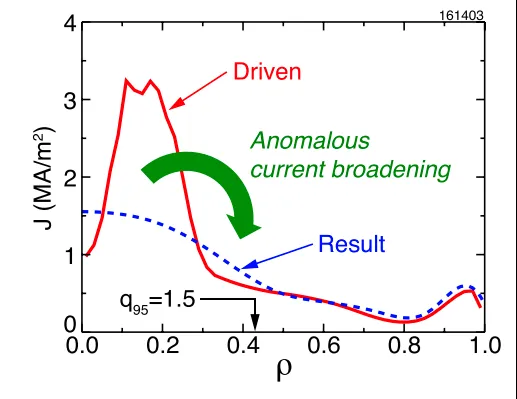
Electron cyclotron current drive (ECCD), the most proven reactor compatible means of current drive, is most efficient injected at the very center of a plasma's magnetic axis. Noninductive scenarios often feature broad current density profiles, requiring off-axis and therefore inefficient current deposition. Hybrid plasmas feature a benign core MHD mode that redistributes core plasma current to the midradius, even if the majority of current is driven on axis. This effect coupled with the bootstrap current delivered by a high pressure pedestal accomplishes efficient off-axis current drive. Broadness in current profiles is favorable to steady state operation as this prevents the magnetic field from twisting up too much, which can trigger damaging disruptions.
Due to its self-organization, the hybrid is also resilient to temporary lapses in noninductive current drive, a foreseeable issue in a steady state reactor expected to run for extended periods of time. The central solenoid could be used to start up the plasma, turned off, then reactivated temporarily to sustain or even reenter the hybrid regime. This quality is not common among steady state scenarios, as access to each requires tailored conditions.
Present research includes quantitatively relating Ideal and Resistive MHD stability limits and raising these limits by tuning kinetic profiles. Operation at higher pressure raises the bootstrap current fraction, reducing the recycled power required to drive current, thus increasing fusion gain.
The Enhanced D-alpha (EDA) H-mode and its higher-power extension, the Quasi-Continuous Exhaust (QCE) regime, constitute an intrinsically ELM-free operating scenario in tokamak plasmas. In these regimes, high confinement is sustained while edge transport is regulated by continuous, benign fluctuations rather than by intermittent edge-localized modes. By replacing impulsive ELM crashes with quasi-steady edge transport, these regimes achieve high confinement with manageable exhaust, making them strong candidates for steady-state, reactor-relevant operation.