![Toroidal current density, poloidal current density, fluid velocity, and pressure variation in a toroidally conducting blanket lead-lithium blanket for three time points during a plasma vertical displacement event. [Guizzo et al. 2026]](/sites/fusion.columbia.edu/files/styles/cu_crop/public/content/blanket/vde_fields_0.png.webp?itok=mZTVfOHy "Toroidal current density, poloidal current density, fluid velocity, and pressure variation in a toroidally conducting blanket lead-lithium blanket for three time points during a plasma vertical displacement event. [Guizzo et al. 2026]")
Breeding Blanket
A commercially viable deuterium-tritium fusion device needs a blanket to shield against neutrons and produce tritium. Columbia’s research in this area is focused on extracting tritium from the blanket and modeling how conducting blanket concepts interact with plasma dynamics.
Fusion of deuterium and tritium (D-T fusion) is the most energetically favorable fusion reaction at the lowest temperatures, therefore most fusion research targets D-T fusion. Tritium is extremely rare in nature, so a commercially viable fusion device must breed its own tritium using products of the fusion reaction (neutrons and an alpha particle). This can be achieved through a reaction between lithium and an outgoing neutron. Therefore, fusion scientists plan to fill space between the magnets and the plasma with a lithium-containing material to breed tritium and shield the magnets and other components from outgoing neutrons.
Blanket Research
Molten salts, particularly FLiBe, have gained traction as a candidate blanket material, making extraction of tritium from molten salt essential. Vacuum-sieve-trays have previously been explored for tritium extraction from lead-lithium (another candidate blanket material), but they have not yet been explored for molten salt, which has a different viscosity and different fluid dynamics. In a VST, a pressure differential pulls liquid breeder material through a nozzle to form droplets, which then fall in vacuum. The droplets maximize surface area, allowing tritium to diffuse out of them as they fall. Droplets also oscillate as they fall, which may circulate the liquid in the droplet, enhancing the extraction process. The Columbia Tritium Extraction EXperiment (C-TEX) will investigate the extraction efficiency of a VST to extract hydrogen from molten salt as a function of nozzle geometry. It will use FLiNaK as a surrogate for FLiBe and deuterium as a surrogate for tritium. A residual gas analyzer will be used to measure the extraction of deuterium and a fast camera will characterize droplet behavior.
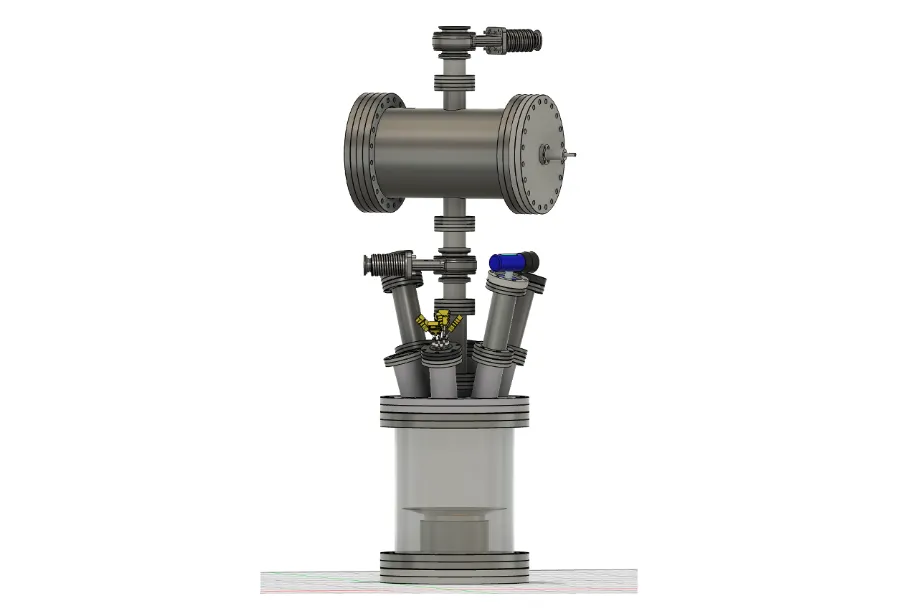
Columbia Fusion Research Center staff have not previously worked with molten salts and the engineering constraints they bring. Therefore, before building the VST, C-TEX is building a prototyping chamber to learn how to prepare FLiNaK, the pitfalls of working with it, and to test candidate VST components. The prototyping chamber consists of a mixing chamber, a melting chamber, and a series of ports for instrumentation and control. C-TEX will mix the constituent salts in a glovebox to prevent exposure to air, then place them in a sealed, detachable mixing chamber to bring them to the main experimental setup. The salt will be dispensed from the mixing chamber into the melting chamber, where it will land in an inconel crucible. The crucible will be heated from the sides by a ceramic band heater and from the bottom by several ceramic pad heaters. The heaters and crucible sit atop ceramic blocks to prevent the surrounding vacuum structure from overheating. An inconel sheathed thermocouple will measure the salt temperature, with more thermocouples measuring the temperatures of important surfaces.
Many candidate breeding blanket concepts employ electrically conducting fluids that circulate through channels and tanks, resulting in interactions with the strong magnetic fields of magnetic confinement fusion devices. In liquid-metal blankets, these magnetohydrodynamic (MHD) effects can be substantial because of the fluid's high electrical conductivity. In molten-salt blankets, electromagnetic coupling is weaker but remains non-negligible. While the interaction between the blanket flow and the background toroidal field in tokamak devices has been the subject of extensive research, the potential impact of electromagnetic coupling between the plasma and blanket during plasma transients is less well understood.
To investigate blanket dynamics during plasma transients, simplified models are being developed within the framework of the OpenFUSIONToolkit (OFT), an open-source suite of finite-element codes for plasma and fusion research developed and maintained by the Columbia Fusion Research Center. TokaMaker, the tokamak equilibrium solver within OFT, supports nonlinear equilibrium evolution in the presence of static conducting structures. This capability has recently been extended to include flowing conducting regions through an axisymmetric, time-dependent incompressible MHD model that evolves the fluid dynamics within blanket domains. The MHD formulation builds upon MHD on Unstructured Grids (MUG), a three-dimensional, time-dependent MHD code in OFT originally developed for plasma simulations. The combined tool can be used to self-consistently and efficiently evolve the plasma and conducting blanket, and determine the induced currents, flows, and pressure variations in the blanket due to a transient event in the plasma.
A preprint describing this work can be found here!