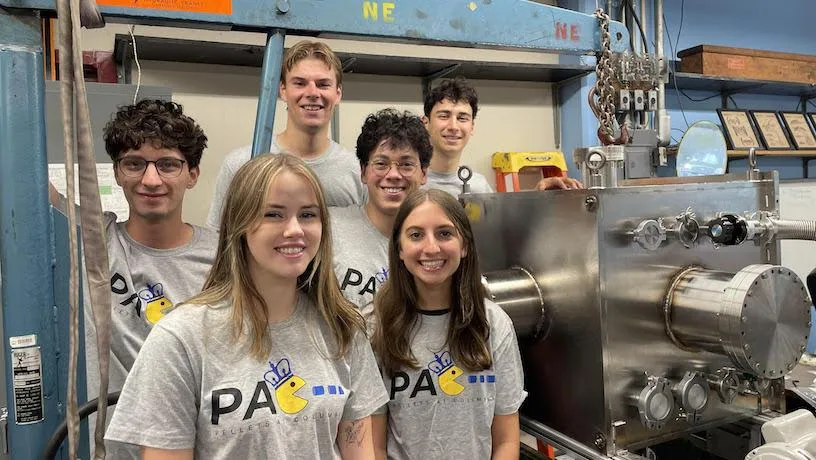
Columbia Engineering undergraduates lead a team to quantify the interaction of cryogenic ice pellets with energetic particle beams to better understand their behavior in fusion plasmas.

Applied physicist recognized for work in controlled fusion
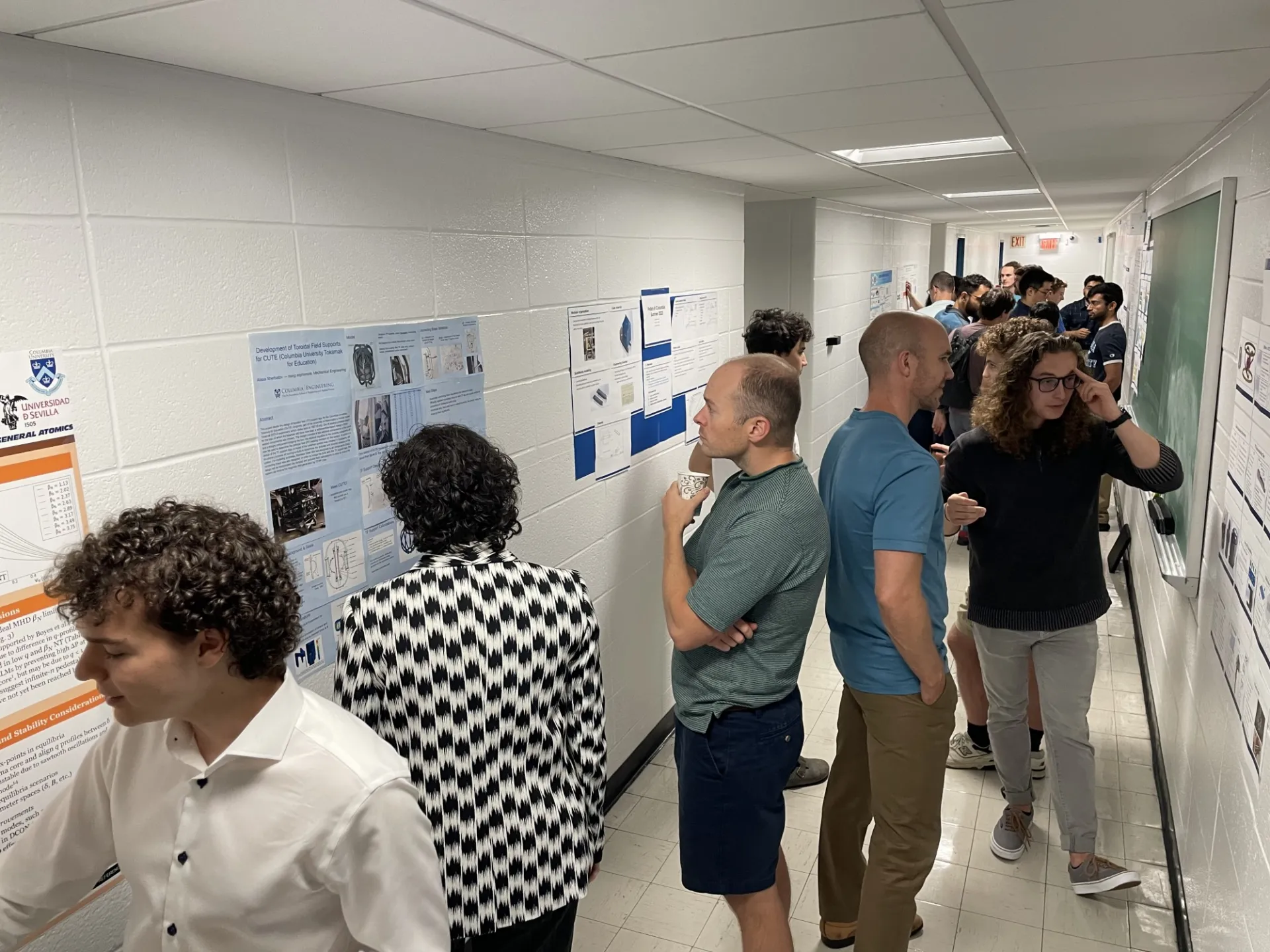
15 faculty, scientists and students presented research at Princeton Plasma Physics Laboratory July 19-21.

A team of Columbia Engineering PhD students have been awarded $22,000 for winning a design contest that challenged university teams across the country to accelerate the commercialisation of fusion energy. The Columbia team was composed of PhD students studying plasma physics in the APAM Department, and their work was supported by Columbia research scientist Dr. Oak Nelson.
The Plasma Physics Laboratory at Columbia Engineering is proud to welcome Dr. Elizabeth Paul to the Applied Physics and Applied Mathematics faculty as a tenure-track Assistant Professor of Applied Physics.
Last week, Columbia University students, scientists, and faculty presented seventy-one research presentations at the 64th Annual Meeting of the APS Division of Plasma Physics held at Spokane, WA.
Columbia University graduate students, scientists, and faculty traveled to Pittsburgh, Pennsylvania to attend the 63rd Annual Meeting of the APS Division of Plasma Physics (DPP). This was the first “hybrid” meeting convened by the American Physical Society (APS) since the beginning of the pandemic.
From November 8-12, 2021, over 800 plasma physicists from the U.S. attended in-person and more than 1,200 physicists participated remotely, making the meeting the world’s largest devoted to plasma physics. Members of Columbia University presented 65 presentations on topics ranging from…
A new paper by members of the Plasma Physics Lab was published in Nuclear Fusion describing the use of machine learning methods to reduce the complex multi-dimensional operation space of a tokamak fusion reactor to a much simpler representation.
In tokamak experiments, a disruption is a dramatic event which rapidly terminates a plasma discharge. During a disruption, confinement of the hot plasma inside the reactor chamber is lost, dumping its energy onto the vessel wall and potentially causing damage to the machine through the resulting magnetic force…