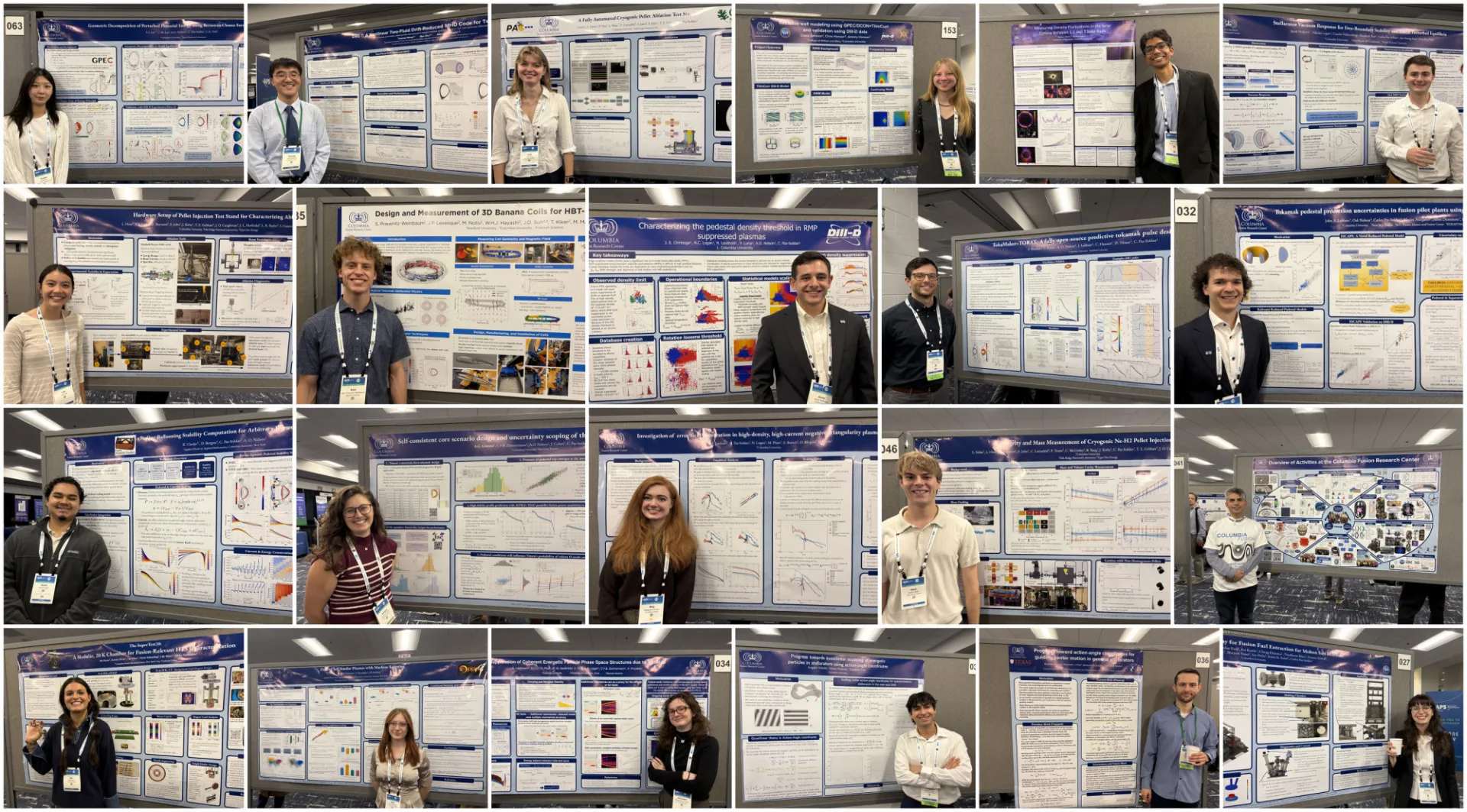
Columbia University students, scientists, and faculty presented their latest research at the 68th Annual Meeting of the American Physical Society Division of Plasma Physics in Chicago, Illinois, from November 2–6, 2026. Contributions from the Columbia Fusion Research Center connected experiments on campus with research at national facilities and the development of technologies for future fusion power plants.
Prof. Carlos Paz-Soldan presented a poster on “Overview of Activities at the Columbia Fusion Research Center,” offering a broad introduction to the center’s research program. The overview poster provided context for the individual contributions presented throughout the meeting, spanning plasma confinement and control, fusion technology, and computational modeling.
Two invited presentations highlighted Columbia’s work on runaway electron mitigation, an important challenge for protecting tokamak components during plasma disruptions.
Carl Friedrich Benedikt Zimmermann presented “Validating benign termination as a reactor-relevant runaway electron mitigation technique on the JET and DIII-D tokamaks.” Combining experimental analysis with plasma modeling, Zimmermann explained differences in runaway electron termination observed on the two devices. The research identified how electron-beam current profiles and resistive plasma instabilities influence termination, providing a common physical picture for evaluating this approach under conditions relevant to future reactors.
Anson Braun presented “Electromagnetic Design of a Non-Insulated Runaway Electron Mitigation Coil Option for ARC and Model Validation on HBT-EP.” Braun described how experiments on Columbia’s HBT-EP tokamak validate predictions of disruption-driven coil currents. The validated modeling tools were then applied to a proposed mitigation coil for ARC. Allowing electrical contact between the coil and surrounding structures simplifies the design and addresses concerns about insulating materials surviving a fusion power plant’s neutron environment. The work illustrates how university-scale experiments can inform engineering decisions for future fusion facilities.
HBT-EP research extended beyond disruption mitigation to the development of new magnetic confinement configurations. Jeffrey Levesque presented “Overview of the HBT-EP program and facility conversion for hybrid operation.” Related contributions explored how stellarator-like magnetic fields could be incorporated into the tokamak: Wataru Hayashi presented “Boozer surface optimization of a university-scale flexible tokamak-stellarator hybrid,” while Jacob Halpern presented “Feasibility of a Flexible, Hybrid Tokamak-Stellarator Experiment using an Axisymmetric Dipole Coil Array.” Rohan Lopez addressed the challenge of managing plasma exhaust in “Investigation of Divertor Configurations for the Scaled-Up Columbia Reconfigurable EXperiment.”
The stellarator program also brought together plasma physics, magnet development, and exhaust design. Dylan Schmeling presented “Design and Testing of Non-Planar NI-HTS Magnets for the Columbia Stellarator eXperiment (CSX).” Complementary work included Lily Shure’s “Advancing HTS Critical Current Characterization under Fusion-Relevant Conditions” and Melanie Russo’s “A 20 K, Background-Field Test Chamber for Fusion-Relevant HTS Characterization.”
Computational research connected these experimental efforts with predictive tools for fusion development. Christopher Hansen presented “The Open FUSION Toolkit: An open-source suite of fusion modeling tools for engineering, analysis, and education.” Frederick Sheehan’s “TokaMaker+TORAX: A fully open-source predictive tokamak pulse design workflow” and “ARC full-pulse design study using open-source TokaMaker+TORAX workflow” illustrated applications to planning tokamak operation. Oak Nelson presented “Integrated Validation of Edge Physics Models and Analysis Workflows for Fusion Pilot Plant Design,” addressing the connection between validated plasma models and power-plant design.
Other contributions examined the physics needed for reliable tokamak operation. Daniel Burgess presented “Empirical Validation of Slab Model Classical Tearing Stability Predictions,” while Evan Bursch presented “Disruption-Free Tokamak Error Field Identification in a Single Discharge Using Magnetic Island Healing.” These studies complemented Columbia’s broader work on plasma stability, magnetic-field correction, and disruption forecasting.
The program also reached beyond confinement physics to the fusion fuel cycle. Eleanor Winkler presented “A Prototype Vacuum-Sieve-Tray for Fusion Fuel Extraction from Molten Salt Blankets,” describing progress toward the Columbia Tritium Extraction Experiment. The project investigates an approach to recovering hydrogen isotopes from molten salts, addressing a technology needed to sustain deuterium–tritium fusion.
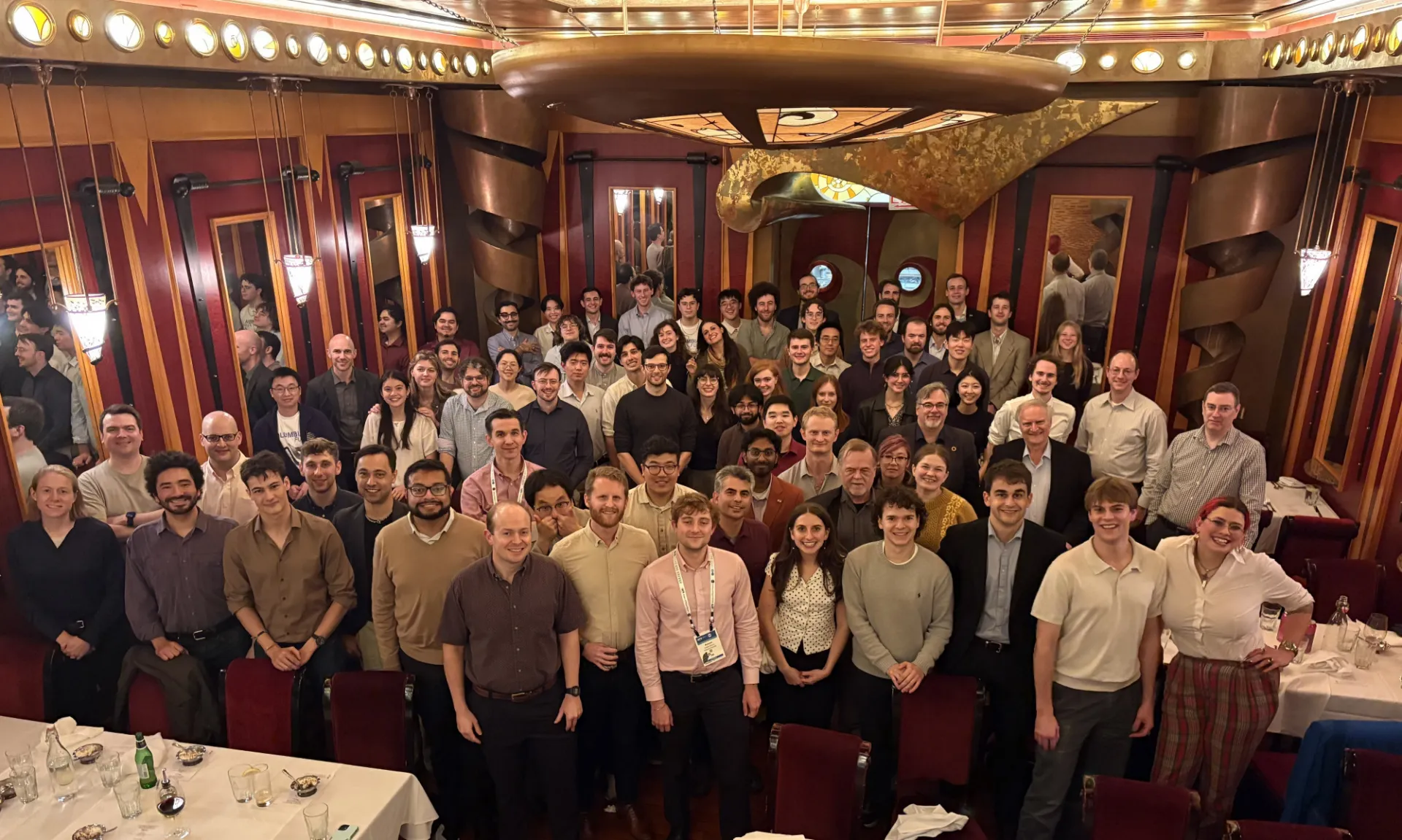
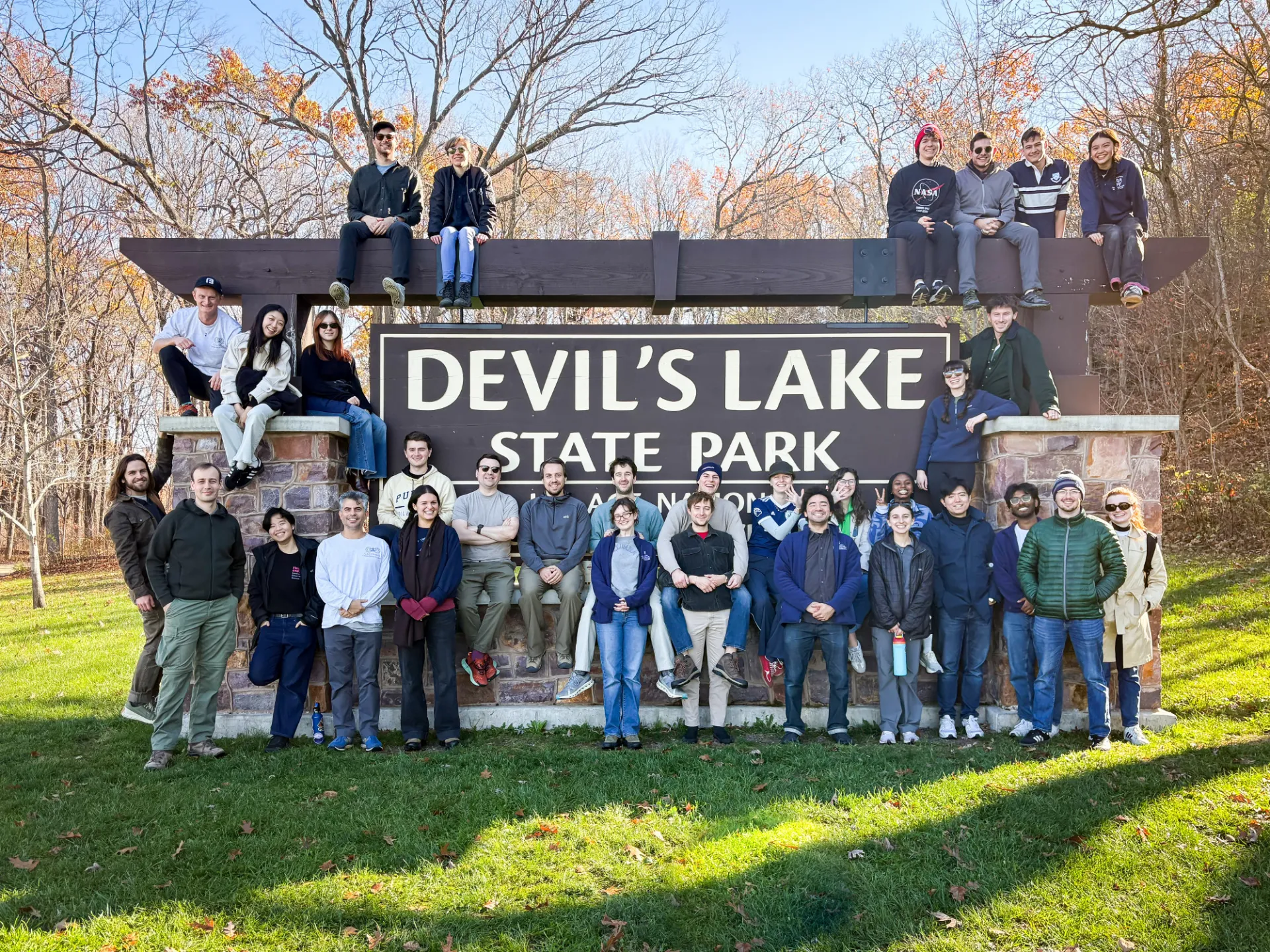
The meeting also provided an opportunity to renew connections across generations of Columbia plasma physicists. The Columbia plasma physics alumni dinner (pictured above) brought together more than 80 attendees to reconnect with colleagues, exchange research news, and celebrate the community’s continuing contributions to fusion science. A post-conference retreat at Devil's Lake, Wisconsin, was also held.