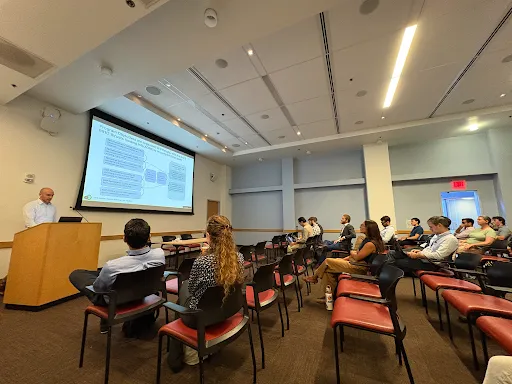
Eleven members of the Columbia Fusion Research Center (CFRC) traveled to San Diego, California, July 13–16 to participate in the 2026 MHD Stability Control Workshop, an annual meeting sponsored by the U.S. Department of Energy Office of Fusion Energy Sciences Tokamak Research program. Five of the attendees were graduate students, underscoring CFRC's commitment to training the next generation of fusion scientists. Graduate student Evan Bursch delivered an invited presentation on "Disruption-Free Error Field Identification in a Single Discharge," while Research Scientist Nikolas Logan, a member of the workshop organizing committee, presented the invited overview "Overview of Integrated Core and Edge MHD Instability Control for Metallic Wall Tokamaks." The workshop also marked the first annual reporting meeting for the four Control of Damaging Transients topical areas: Mitigating Disruptions, Mitigating ELMs, Suppressing MHD Instabilities, and Avoidance of Off-Normal Events.
Throughout the week, CFRC researchers and students presented work spanning disruption prediction and avoidance, error field physics, edge stability, and advanced plasma control, highlighting the breadth of the center's research program and its collaborations across the international fusion community. Together, these contributions demonstrated Columbia's leadership in developing the scientific foundations for reliable, high-performance tokamak operation while providing valuable opportunities for graduate students and early-career researchers to engage with the broader fusion community. Additional information about the workshop, including the technical program, can be found at https://fusion.gat.com/conference/event/138/.