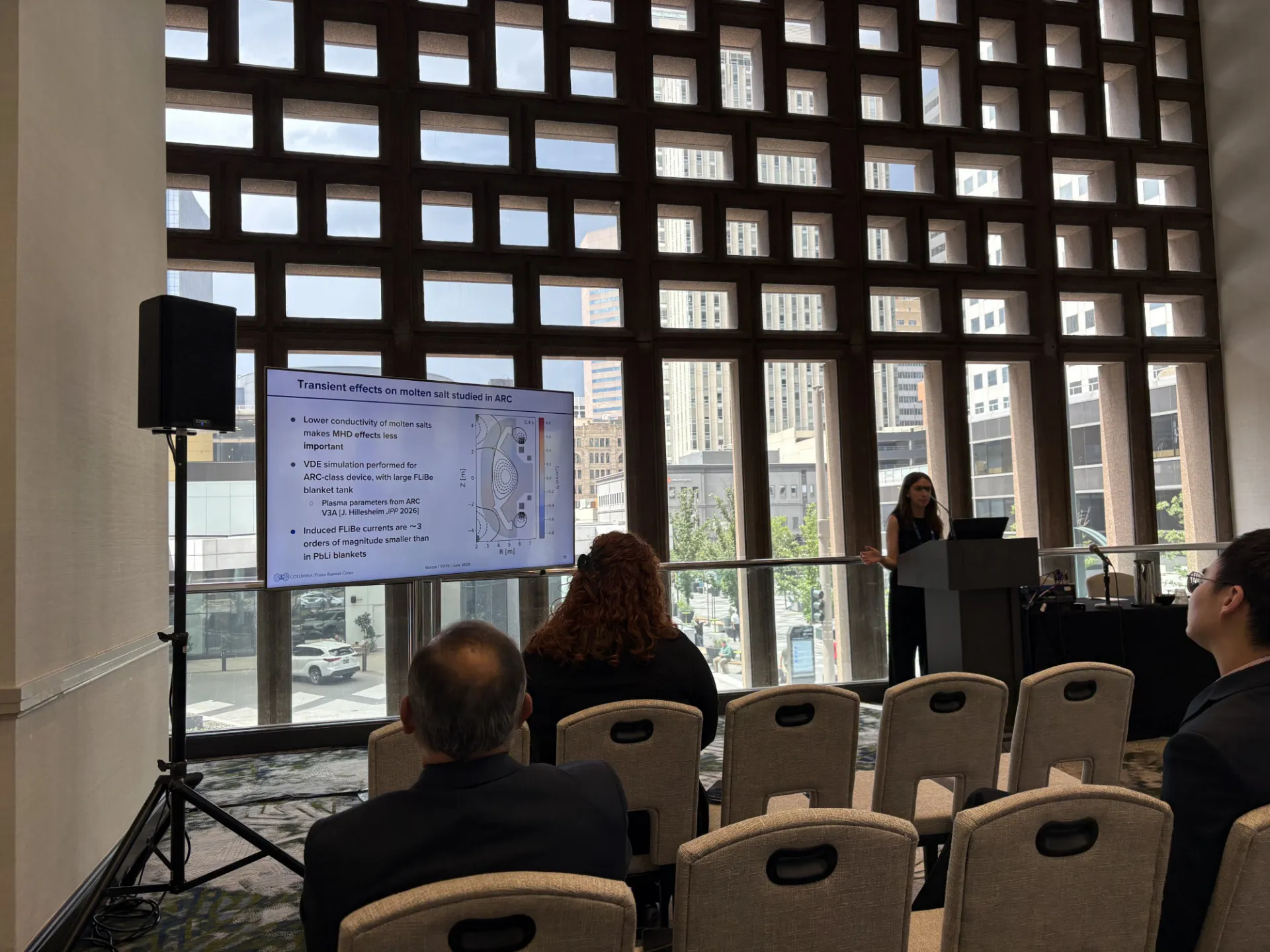
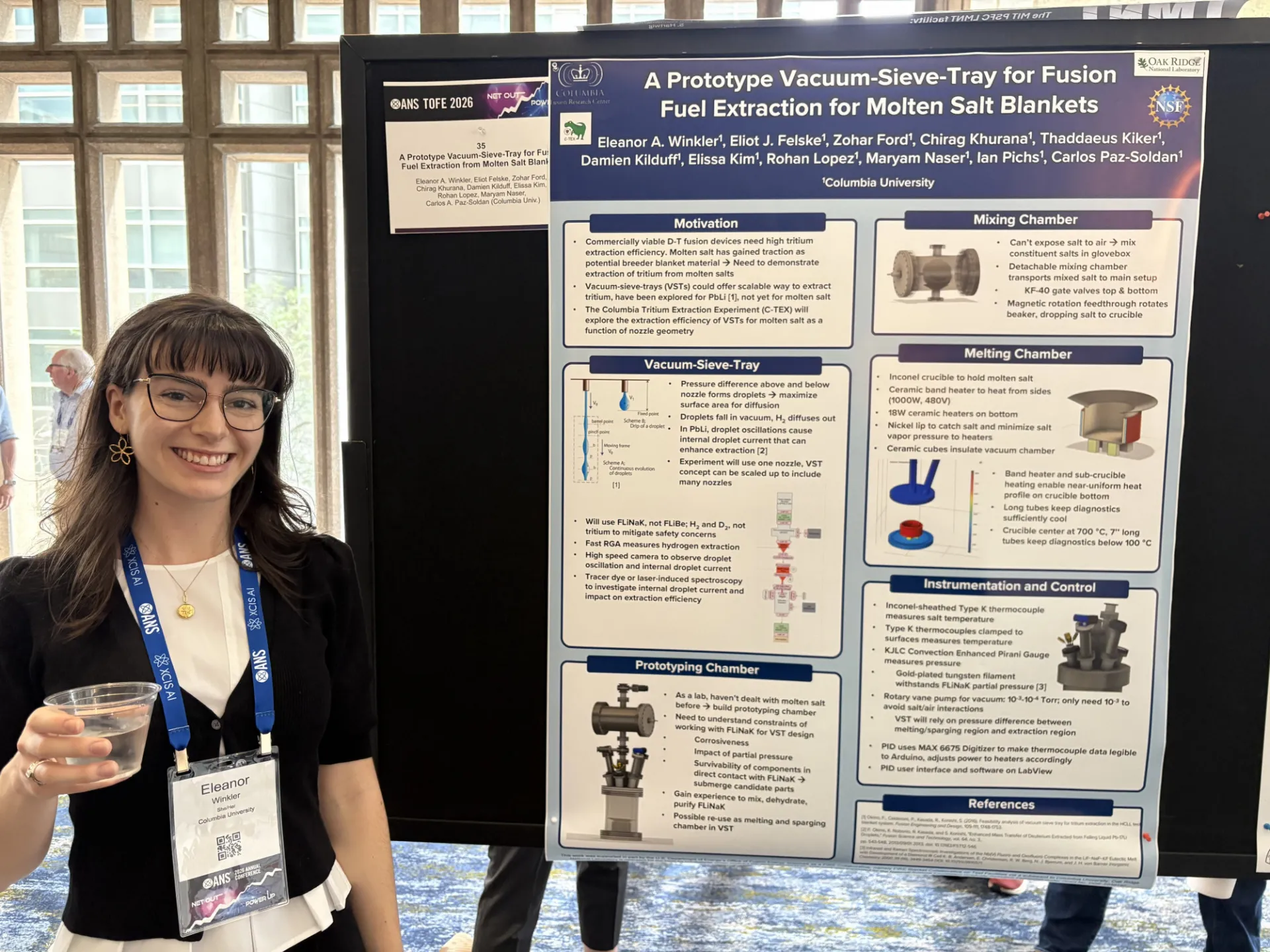
Members of the Columbia Fusion Research Center attended the 2026 Technology of Fusion Energy (TOFE) Conference, hosted by the Fusion Energy Division of the American Nuclear Society in Denver, Colorado, from June 1–3, 2026. A central focus of TOFE was the development of tritium breeding blankets, a critical technology for a fusion pilot plant. The Fusion Research Center has developed two new blanket initiatives as part of a Department of Energy collaborative led by Oak Ridge National Laboratory. Computational contributions to blanket development were presented by graduate student Sophia Guizzo, who has developed a coupled plasma-liquid metal magnetohydrodynamic solver for modeling breeding blanket dynamics. This work was awarded the TOFE 2026 student paper award. Progress in experimental validation of tritium extraction methods and material compatibility is also underway at the Fusion Research Center, as showcased by Graduate student Eleanor Winkler’s poster on the design of the Columbia Tritium Extraction eXperiment (CTEX), including a new molten salt test stand.
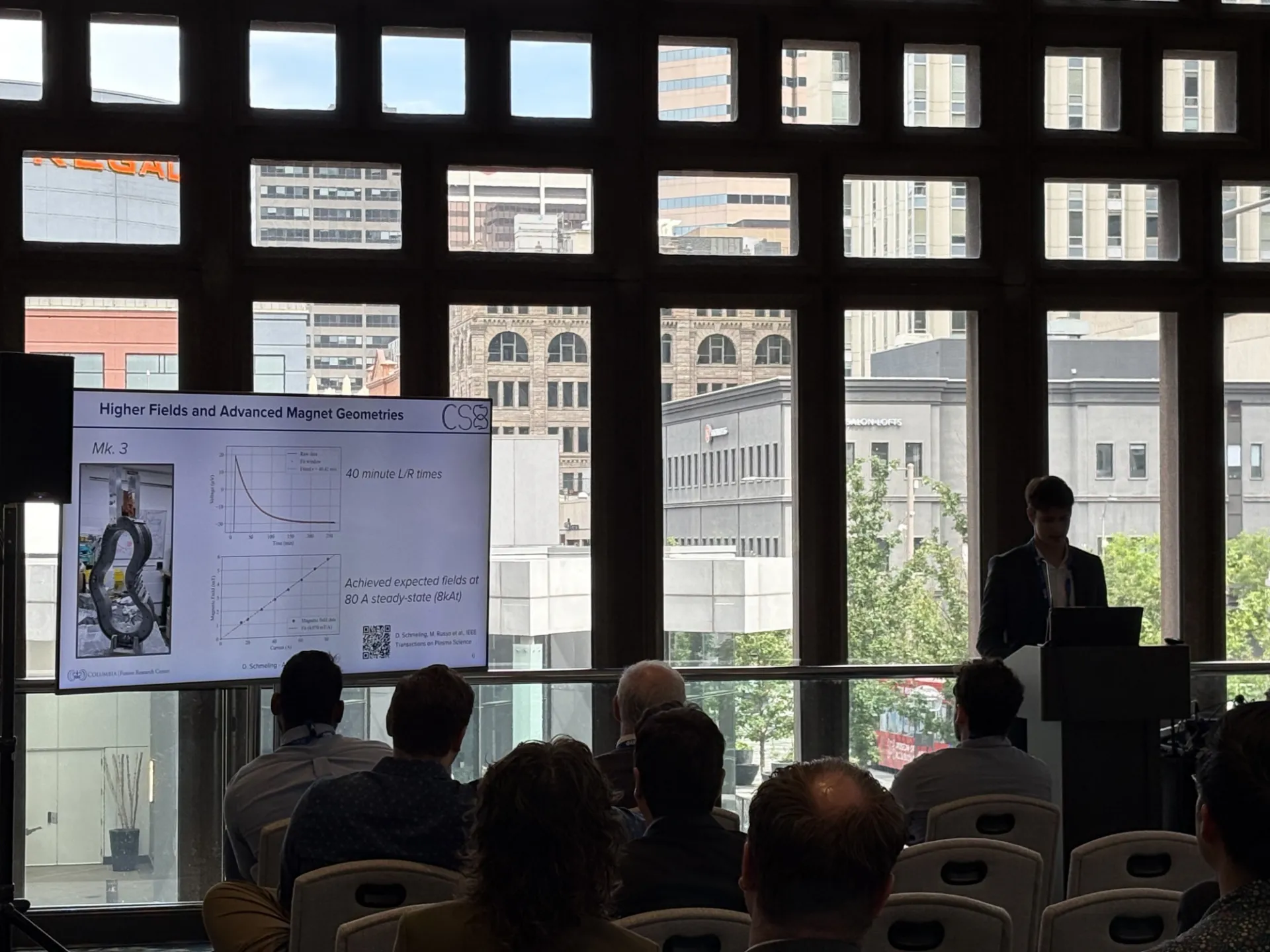
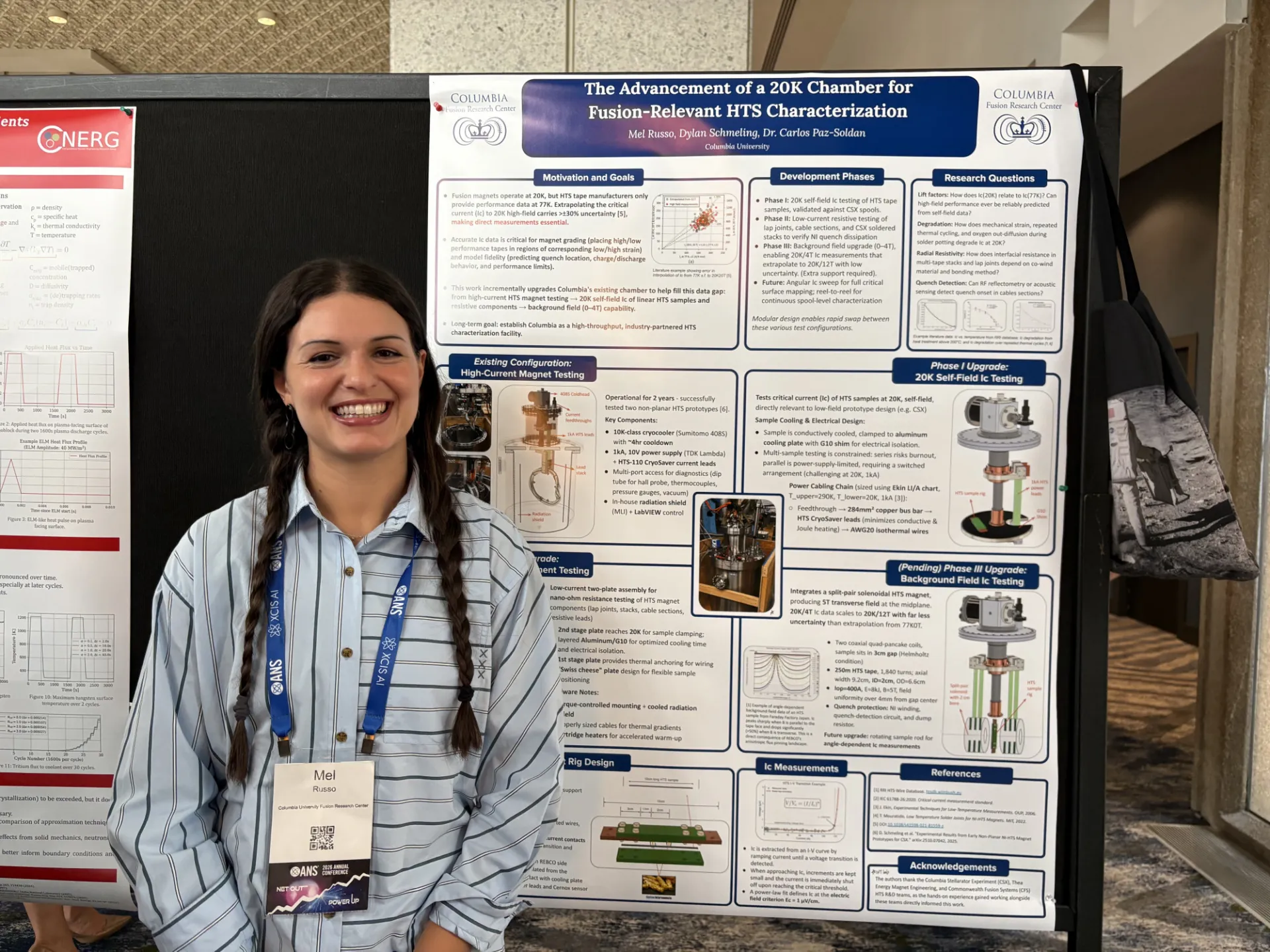
Another significant topic of TOFE was magnet design and engineering. Ongoing efforts in this topic were presented by graduate student Dylan Schmeling, who presented recent developments in prototype high-temperature superconducting (HTS) magnets for the Columbia Stellarator Experiment. As an extension into the broader space of general magnet characterisation, graduate student Melanie Russo presented a novel HTS magnet test stand design for the Columbia Plasma Laboratory.
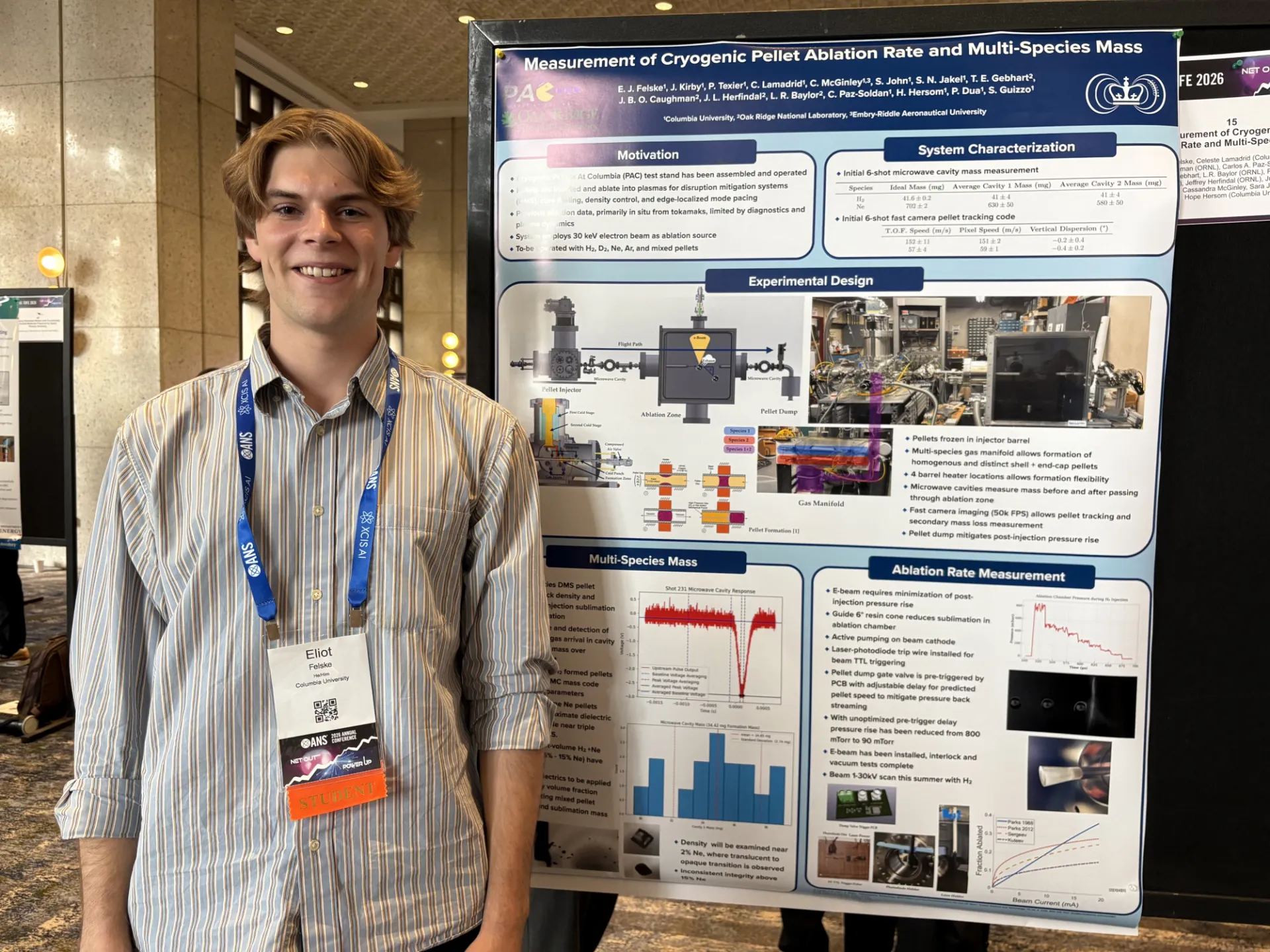
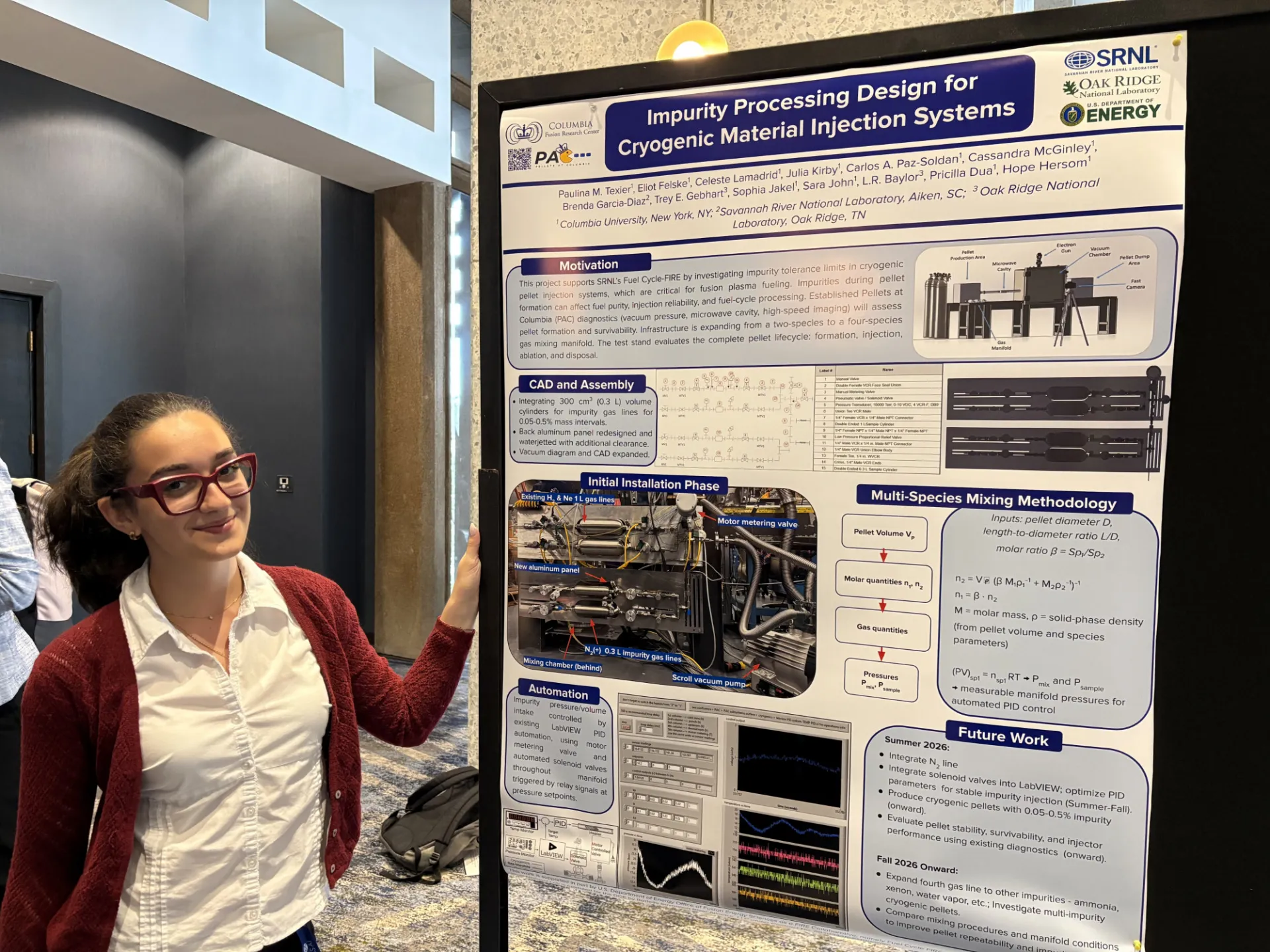
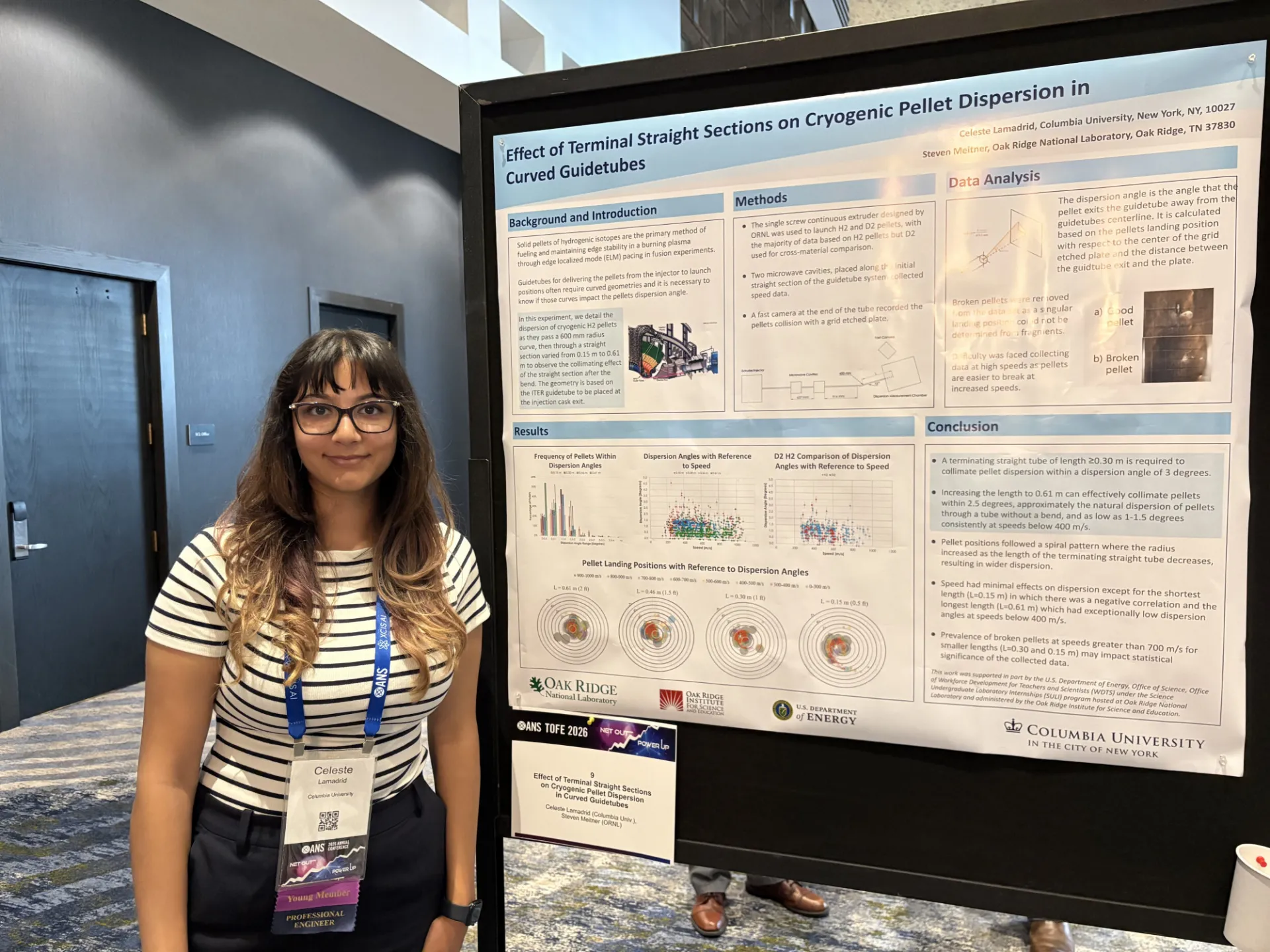
Fusion fuel cycle technology has consistently been a core subject of TOFE. Columbia’s ongoing research in cryogenic pellet fueling was highlighted by graduate student Eliot Felske, presenting recent progress on the Pellets At Columbia (PAC) experiment, including the formation and diagnosis of mixed cryogenic Neon-Hydrogen pellets and the installation of a high-energy electron beam for pellet ablation. Recently graduated undergraduate student Paulina Texier showcased the installation of new gas lines on PAC to seed fuel cycle impurities into cryogenic pellet formation, in collaboration with Savannah River National Laboratory. The fuel cycle program at Columbia has benefited from continuous collaboration with Oak Ridge National Laboratory, as recently graduated undergraduate student Celeste Lamadrid demonstrated in her presentation on the characterization of the dispersion and integrity of cryogenic pellet injection through guide tubes, conducted at Oak Ridge.
Professor Carlos Paz-Soldan summarized these breeder blanket, HTS magnet, and pellet fueling research efforts in an overview of recent fusion technology developments at the Columbia Fusion Research Center. Additional fusion device modeling was presented by Research Scientist Oak Nelson, demonstrating open-source coupled modeling tools for fusion pilot plants to self-consistently design and evaluate both plasma scenarios and device engineering requirements. The Columbia contributions to TOFE 2026 highlight the Fusion Research Center's broadening scope and expertise, with increasing efforts in fusion engineering and enabling technologies. These activities continue to expand workforce development pathways in these increasingly critical fusion engineering fields as fusion energy draws closer to reality.