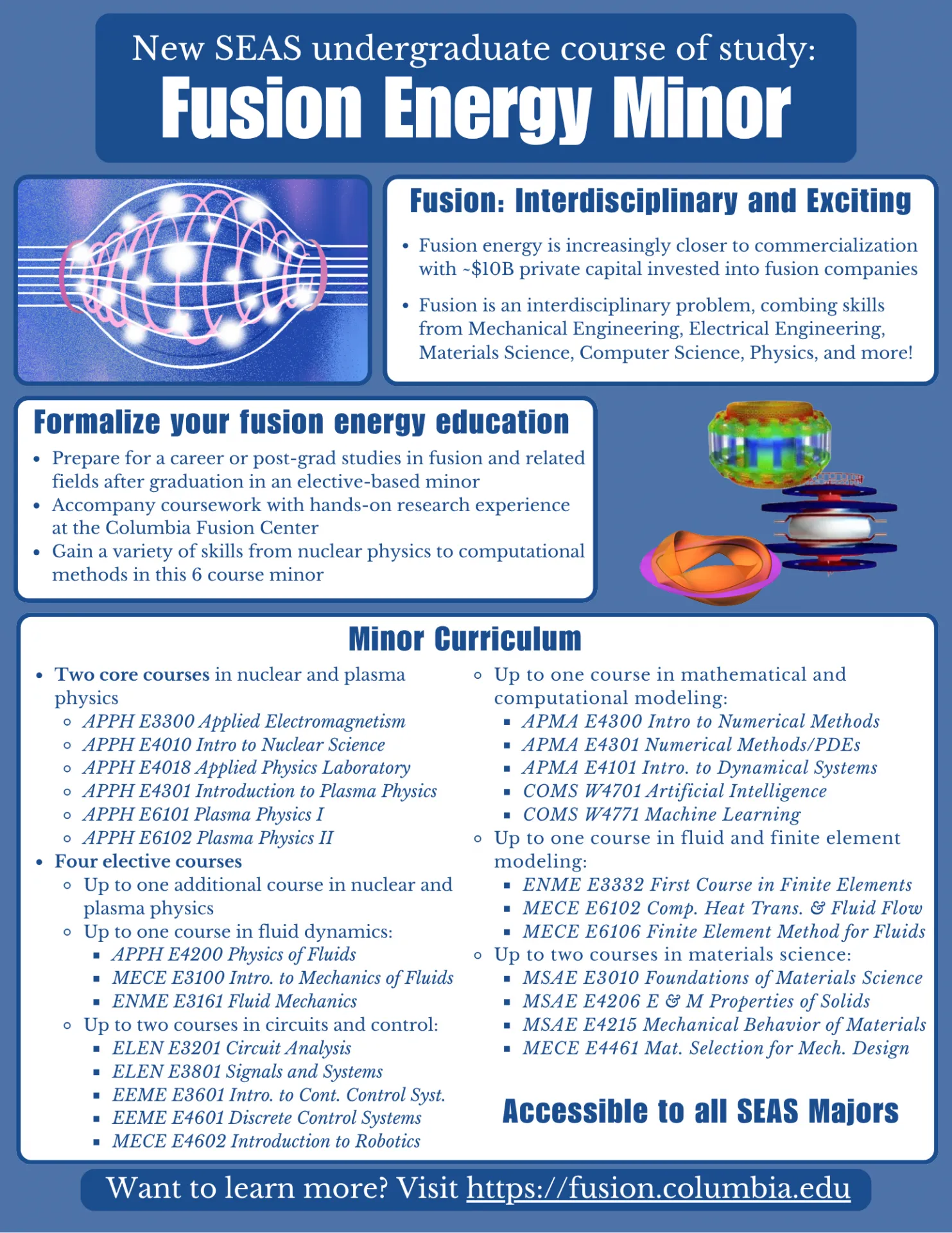
Fusion Energy Minor
Columbia Engineering offers an undergraduate Fusion Energy Minor!
As fusion energy nears commercialization, the need for an interdisciplinary workforce is growing. Developing fusion technologies draws on mechanical and electrical engineering, materials science, computer science, physics, and more. To prepare students for these emerging opportunities, Columbia offers an undergraduate Fusion Energy Minor, open to all majors in the School of Engineering and Applied Science (SEAS).
This six course program provides a strong foundation in the science and engineering of fusion and builds practical skills across subfields relevant to the fusion industry.
1-2. Two of the following core courses in nuclear and plasma physics:
APPH E3300: Applied Electromagnetism (3)
APPH E4010: Intro to Nuclear Science (3)
APPH E4018: Applied Physics Laboratory (3)
APPH E4301: Introduction to Plasma Physics (3)
APPH E6101: Plasma Physics I (3)
APPH E6102: Plasma Physics II (3)
3-6. Four of the following elective courses:
Up to one additional course in nuclear and plasma physics:
APPH E3300: Applied Electromagnetism (3)
APPH E4010: Introduction to Nuclear Science (3)
APPH E4018: Applied Physics Laboratory (3)
APPH E4301: Intro to Plasma Physics (3)
APPH E6101: Plasma Physics I (3)
APPH E6102: Plasma Physics II (3)
Up to one course in fluid dynamics:
APPH E4200: Physics of Fluids (3)
MECE E3100: Introduction to Mechanics of Fluids (3)
ENME E3161: Fluid Mechanics (4)
Up to two courses in circuits and control:
ELEN E3201: Circuit Analysis (3.5)
ELEN E3801: Signals and Systems (3.5)
EEME E3601: Introduction to Continuous Control Systems (3)
EEME E4601: Discrete Control Systems (3)
MECE E4602: Introduction to Robotics (3)
Up to one course in mathematical and computational modeling:
APMA E4300: Intro to Numerical Methods (3)
APMA E4301: Numerical Methods/PDEs (3)
APMA E4101: Introduction to Dynamical Systems (3)
COMS W4701: Artificial Intelligence (3)
COMS W4771: Machine Learning (3)
Up to one course in fluid and finite element modeling:
ENME E3332: A First Course in Finite Elements (3)
MECE E6102: Computational Heat Transfer and Fluid Flow (3)
MECE E6106: Finite Element Method for Fluid Flow
Up to two courses in materials science:
MSAE E3010: Foundations of Materials Science (3)
MSAE E4206: Electric and Magnetic Properties of Solids (3)
MSAE E4215: Mechanical Behavior of Materials (3)
MECE E4461: Materials Selection for Mechanical Design (3)